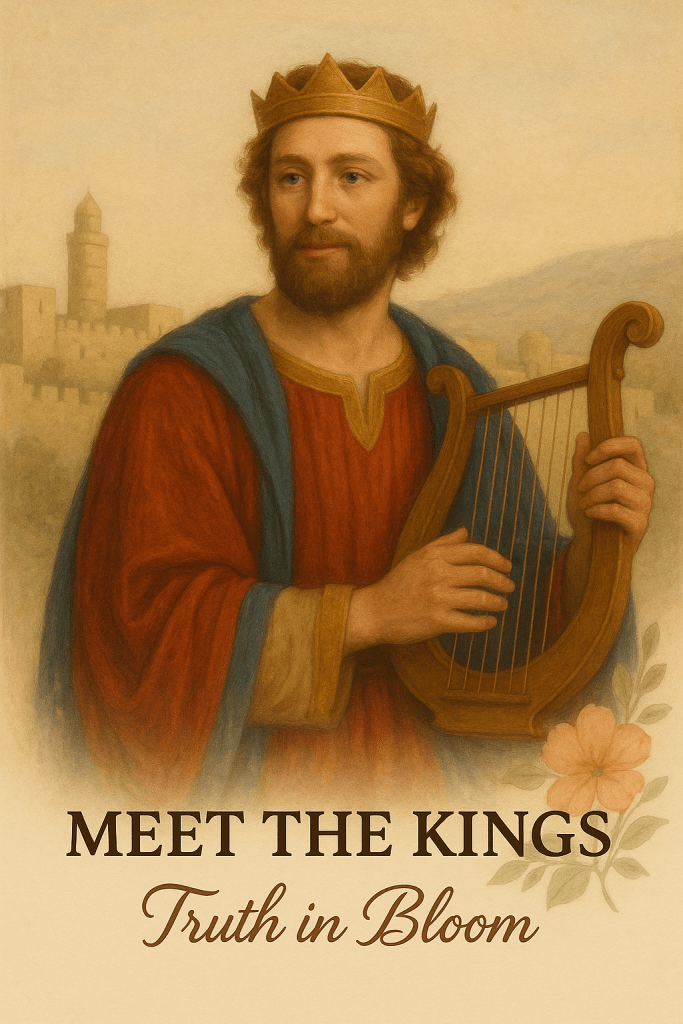
Reign: c. 1010–970 BC
Scripture Focus: 1 Samuel 16 – 1 Kings 2; Psalms
When the prophet Samuel was sent to anoint a new king to replace Saul, even he was tempted to choose based on appearance. But God corrected him:
“The Lord does not look at the things people look at. People look at the outward appearance, but the Lord looks at the heart.” (1 Samuel 16:7)
That’s how we meet David.
A shepherd boy. The youngest of eight. Overlooked by everyone except God.
David’s story is one of tension and triumph, flaws and faithfulness. He was a warrior, a poet, a musician, and a king. He made devastating mistakes, but what marked him most wasn’t his perfection—it was his heart for God.
He repented. He trusted. He worshipped.
He never claimed the throne by force. He waited on God’s timing. And even when faced with Saul’s jealousy and attempts on his life, David chose mercy.
He was the king Israel didn’t know it needed—a man deeply human, deeply flawed, and yet deeply surrendered to the Lord. His psalms still give voice to our joys and our griefs. His story reminds us that God is not looking for perfect leaders, but available hearts.
Key Events in David’s Life and Reign
• Anointed by Samuel (1 Samuel 16): God chooses David, the youngest son of Jesse, to be king while he is still a humble shepherd.
• Defeats Goliath (1 Samuel 17): David, empowered by faith and not by sword or armor, defeats the Philistine giant, showing that God’s power triumphs through the unlikely.
• On the Run from Saul (1 Samuel 18–31): Though David has multiple chances to kill Saul, he spares his life—demonstrating reverence for God’s anointed and a commitment to God’s timing.
• King Over Judah, Then All Israel (2 Samuel 2–5): After Saul’s death, David is anointed king over Judah and later over all Israel, unifying the kingdom and establishing Jerusalem as its capital.
• Brings the Ark to Jerusalem (2 Samuel 6): David brings the Ark of the Covenant into Jerusalem with joy and dancing, centralizing worship in the holy city.
• God’s Covenant with David (2 Samuel 7): God promises David an everlasting dynasty, a covenant that ultimately points to the Messiah.
• Sin with Bathsheba (2 Samuel 11): David commits adultery and orchestrates the death of Uriah. This marks a turning point in his reign.
• Repentance and Consequences (Psalm 51, 2 Samuel 12): David acknowledges his sin with raw honesty, expressing deep remorse and surrender.
• Family Strife and Civil Unrest: David’s household suffers as a result of his sin—betrayal, violence, and rebellion emerge from within.
• Prepares for the Temple (1 Chronicles 28–29): Though told he cannot build the temple, David makes detailed preparations and gifts generously, showing that his heart was set on worship.
Themes to Reflect On
• God Sees the Heart: The essence of godly leadership is found in inward surrender, not outward stature.
• The Long Path of Obedience: David’s journey from anointing to enthronement is marked by waiting, wilderness, and worship.
• The Depth of Grace: David’s sin was great, but God’s mercy was greater. His story is a case study in repentance and restoration.
• Worship Through Every Season: Whether in the cave or on the throne, David poured his heart out in worship. His psalms teach us to bring everything—joy, fear, failure—to God.
• The Cost of Compromise: David’s choices, especially in his personal life, had far-reaching consequences. Yet his willingness to own them sets him apart.
What We Learn from David
1. God delights in a surrendered heart more than a spotless record.
2. True worship is honest, raw, and rooted in relationship.
3. Repentance is the doorway back to God, even after failure.
4. Spiritual legacy is built not on perfection but on continued pursuit of God.
5. Leadership must be held loosely—entrusted fully to God’s timing and purposes.
How This Points to Jesus
David was called a man after God’s own heart—but even he wasn’t the perfect king. He points us to someone greater.
• Like David, Jesus was a shepherd—but His flock is eternal.
• Like David, Jesus faced enemies—but His victory was over sin and death.
• Unlike David, Jesus never sinned. He obeyed perfectly, surrendered fully, and led with truth and grace.
• David longed to build God’s house. Jesus became the cornerstone of it.
Jesus is the fulfillment of the promise God made to David: a King whose reign would never end.
“The Lord God will give Him the throne of His father David, and He will reign forever…” (Luke 1:32–33)
Discussion or Reflection Questions:
• What does it mean to be someone after God’s own heart in today’s world?
• Where in my life is God asking me to wait, trust, or show mercy like David did with Saul?
• How do I respond when confronted with my own sin? Do I run, hide, justify—or repent?
• In what areas am I leading others, and how can I model both strength and humility?
• Do I approach God with the honesty and depth of worship that David did, even in seasons of failure?
Coming next: Solomon – The King Who Asked for Wisdom
#MeetTheKings #KingDavid #TruthInBloom #HeartOfWorship #RepentanceAndRestoration #JesusOurKing
 Truth in Bloom